
One meal, nine ways to enjoy mochi.
Kaho mochi (果報餅, kahō mochi) brings together nine flavours from the mochi food culture of Ichinoseki and Hiraizumi in southern Iwate. Sweet bean paste is part of the selection, alongside savoury ingredients such as freshwater shrimp, grated daikon and natto. It is a way to experience mochi as a meal as well as a sweet.
At our brewery restaurant, the pleasure begins with the little dishes in front of you. Their colours catch your eye first; then the same soft mochi takes on very different aromas and flavours as you move from one topping to another.
You might start with a familiar sweet flavour, then try something savoury, and return to a favourite at the end. There is no prescribed order. Talking about which dish to try next is part of the enjoyment of sharing the table.
Our frozen selection offers another way to meet this regional food at home in Japan. Visiting Ichinoseki and opening a box in your own kitchen are different experiences, but both can begin with the same question: which flavour would you like to taste first?
Recognise the nine flavours by their Japanese names.
These are the nine flavours introduced in our Japanese article. Keep the original names beside their explanations when you look at the shop or the enclosed information. The descriptions help you understand the food; the current product label remains the reference for exact ingredients.
| Japanese name | What it means | A flavour to explore |
|---|---|---|
| 沼えび | Numa-ebi: freshwater shrimp | A savoury topping that places mochi firmly at the dinner table. |
| じゅうねん | Jūnen: the regional name for egoma, or perilla seed | The aroma and texture of the seeds; compare it with sesame and walnut. |
| ごま | Goma: sesame | A fragrant seed topping to enjoy between lighter flavours. |
| ずんだ | Zunda: mashed green soybeans | A gently sweet way to begin if you enjoy bean flavours. |
| 大根おろし | Daikon oroshi: grated daikon radish | A refreshing change after a sweet or rich mouthful. |
| くるみ | Kurumi: walnut | A nutty flavour to compare with the seed-based toppings. |
| 納豆 | Natto: fermented soybeans | A savoury option with its own distinctive aroma. |
| あんこ | Anko: sweet red bean paste | A familiar sweet starting point for many mochi eaters. |
| きのこおろし | Kinoko oroshi: mushrooms with grated daikon | A savoury topping combining mushroom flavour and grated radish. |
Egoma is different from sesame: the local name jūnen can be unfamiliar even to someone who already knows Japanese food. Zunda and natto both use soybeans but have very different flavours and textures. Learning these distinctions makes the next bite more interesting.
This assortment includes ingredients such as shrimp, walnut, sesame and soybeans. If you have an allergy or a dietary restriction, check the full current ingredient information before ordering. Do not assume that every topping has the same ingredients as plain mochi.
Move between sweet, fragrant and savoury.
If you would like an easy starting point, try anko or zunda. Then move to sesame, walnut or jūnen and notice how the aroma and texture change. A little grated daikon offers a different impression before you return to a richer flavour.
Shrimp, natto and mushroom with grated daikon show another side of mochi. They make sense as part of a meal, rather than as a plate of sweets after dinner. Alternating between these savoury dishes and sweeter ones keeps the tasting varied.
There is no need to guess every topping correctly or to agree on a favourite. Around a shared table, one person may return to zunda while another prefers shrimp. Try describing what you enjoyed: the topping’s aroma, the combination with the rice, or the way a savoury bite changes the next sweet one.
At home, set out small dishes before serving and prepare the amount you intend to eat according to the product’s instructions. Tea or a simple soup can sit alongside the mochi. Choose the number of sets for the meal you have in mind, rather than treating one box as a fixed serving size for every person.
Explore the frozen mochi selectionProduct details and checkout are in Japanese.
The good fortune behind the name.
The name kaho mochi is said to come from 果報団子, dumplings offered to the Buddhist monk Kōbō Daishi. One tradition placed a small twig of hagi, or bush clover, inside some of the dumplings. Finding it was said to bring good fortune.
This is a story about the name and the regional custom, not an instruction to put a twig into food at home. What remains meaningful at the table is the shared anticipation: people gathering around the same meal and wondering who will be fortunate.
Mochi in Ichinoseki and Hiraizumi has long accompanied seasonal events, family milestones, ceremonies and hospitality. It belongs to the times when people come together, as well as to the ingredients on the plate.
Why this region has so many ways to serve mochi.
Ichinoseki and Hiraizumi are known for a mochi culture with around 300 regional dishes. Its history reaches back roughly four centuries. Different household practices, seasonal ingredients and occasions have all contributed to that variety.
Our Japanese article describes しいなもち (shiina mochi), made using imperfect rice grains and other grains in times when good white rice was scarce. Ingredients from fields, rivers and surrounding hills offered ways to make mochi more enjoyable. Sweet dishes, savoury dishes and soups grew out of a range of such local practices.
The story is not only about the number of recipes. It is also about making something welcoming from what is available. The arrival of a season, the end of a task or a family gathering could each have its own place in the local もち暦, or mochi calendar.

Our nine-flavour selection is a small introduction to that wider culture. It cannot represent every household or every dish, but the contrast between sweet and savoury shows why mochi here is more than a single familiar snack.
The region’s mochi culture was also featured by the Japanese television programme マツコの知らない世界 on 28 April 2026. You do not need to have seen the programme to enjoy the food: the ingredients and the people at your table provide a starting point of their own.
Serving mochi at a brewery restaurant.
At Sekinoichi, brewing and welcoming people to the table are both part of what we do. Our brewery restaurant serves the region’s food in a converted brewery building from the Taishō era. Working with rice and water, making mochi and preparing a meal for visitors all connect us to everyday food in Ichinoseki.
Experience serving freshly made mochi also led us to consider how people farther away could enjoy it. Frozen kaho mochi and individually wrapped Pettan Mochi are two different answers: one introduces a range of prepared flavours, while the other leaves the toppings to your own kitchen.
If you visit Ichinoseki, you can explore the local setting as well as the food. If you are ordering to a home elsewhere in Japan, you can begin with a box, the Japanese names of the toppings, and a little time to taste them. Neither experience needs to imitate the other.
Visit our brewery and restaurant website for current visitor information (Japanese) →
Bring the nine flavours to a table at home.
Our Japanese shop lists frozen kaho mochi as one-set, three-set and five-set options. A single set lets you explore the assortment; multiple sets may suit a shared meal or more than one occasion. Check the listing rather than assuming that a set corresponds to a particular number of people.
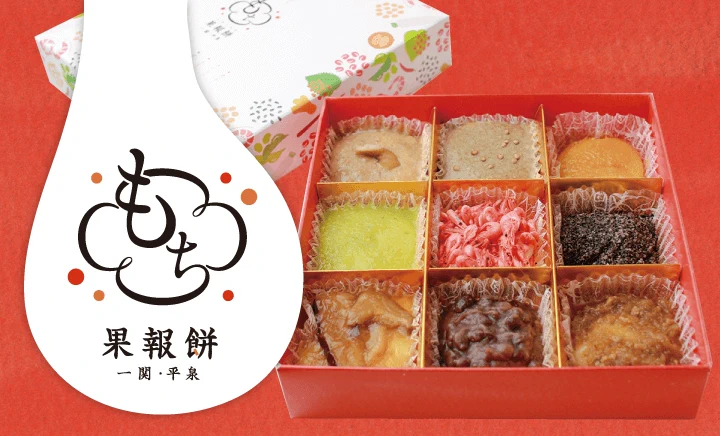
When the parcel arrives, check its condition and place the frozen product in the freezer. For serving, follow the instructions supplied with kaho mochi and prepare the amount you plan to eat. Do not apply the thawing instructions for plain Pettan Mochi to this assortment of toppings.
For a gift or a planned gathering, check the dispatch information before choosing an arrival date. It also helps to tell the recipient that the parcel is frozen and ask whether they have space for it. A larger order means more freezer space, not just more flavours on the table.
Frozen delivery is separate. Kaho mochi cannot be packed with room-temperature or refrigerated products. It also cannot be shipped in the same parcel as our sake or beer; separate delivery charges may apply. Check the product page and cart for the final delivery conditions.
Choose a Kaho Mochi setCurrent prices, availability and delivery information are in the Japanese shop.
Pettan Mochi: choose the toppings yourself.
ぺったんもち (Pettan Mochi) is plain mochi, rather than the nine-flavour assortment. It is made from Iwate-grown Koganemochi glutinous rice and water, shaped into individual 70g portions, wrapped and frozen. You can thaw only the portions you intend to use.
The product information gives approximately three to four hours of natural thawing at room temperature as a guide. Once thawed, enjoy it within two days. Its frozen best-before period is six months from manufacture, rather than six months from the day it reaches you; check the date on your package.
Pettan Mochi contains no preservatives. It gradually firms up after thawing, as ordinary mochi does. The product information suggests cutting and grilling it if it has hardened. Follow the package’s handling instructions and adjust preparation to the actual condition of the mochi.
A different topping for a different day.
Try sweet red bean paste, zunda or kinako, the roasted soybean powder often sold in Japanese supermarkets. For a savoury dish, grated daikon offers another starting point. Plain mochi can also be used in a soup or a zōni-style meal, with preparation suited to the dish.
Tasting kaho mochi first can give you ideas for a later meal with Pettan Mochi. If zunda was your favourite, prepare more of it next time. If you enjoyed the savoury toppings, explore how you like plain mochi with grated radish or soup. The assortment introduces possibilities; the plain mochi gives you room to try your own.
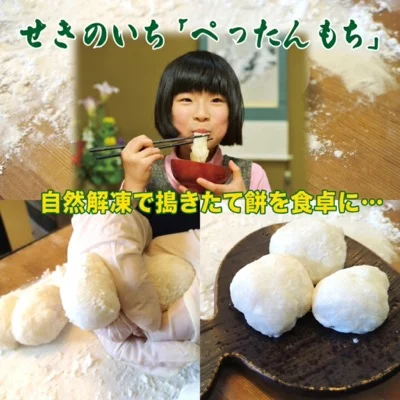
Pettan Mochi · 70g × 5
Individually wrapped plain mochi. Thaw only the portions you plan to use.
Frozen delivery
View this pack →Japanese product page; check current price and availability.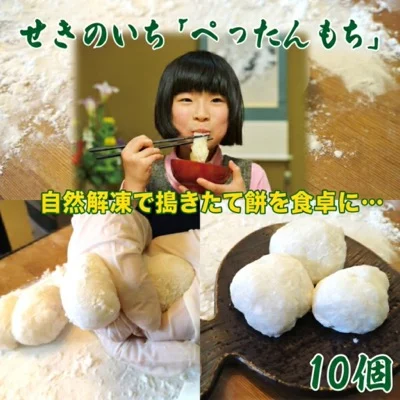
Pettan Mochi · 70g × 10
Individually wrapped plain mochi. Thaw only the portions you plan to use.
Frozen delivery
View this pack →Japanese product page; check current price and availability.The five-portion and ten-portion packs both contain plain 70g pieces. Choose by how many portions you expect to use and the freezer space available. They are frozen products and cannot be packed with sake or beer. Do not assume every frozen item can share one parcel; confirm the cart’s delivery conditions.
Ordering to an address in Japan.
Our product listings, cart and checkout are in Japanese. Use the names 果報餅 and ぺったんもち to keep the two types apart. セット means set, 個 counts individual pieces, and 冷凍 means frozen.
On a product page, 数量 is the number to order and カートに入れる means add to cart. Before continuing through 購入手続き (checkout), check the pack size, the delivery charge and the information about separate shipments.
Read the Japanese shopping guide for the current ordering conditions. If an ingredient or handling instruction is unclear, resolve it before ordering rather than relying on the appearance of a photograph.
Questions about Kaho Mochi and Pettan Mochi.
Is Kaho Mochi a dessert?
It includes sweet flavours and savoury toppings such as freshwater shrimp, natto and grated daikon. It introduces the region’s mochi as part of a meal as well as a sweet.
Can I order it online within Japan?
Our Japanese online shop lists frozen kaho mochi in one-, three- and five-set options. Check current availability, prices and delivery conditions on the listing and in the cart.
What is the difference from Pettan Mochi?
Kaho Mochi is the nine-flavour assortment. Pettan Mochi is plain rice mochi in individual 70g portions, for serving with toppings or dishes you choose.
How do I thaw Pettan Mochi?
The product information gives natural thawing at room temperature for about three to four hours as a guide. Eat within two days after thawing and follow the package instructions. These directions are for Pettan Mochi, not the nine-flavour Kaho Mochi assortment.
Can the mochi and beer arrive in one parcel?
No. The mochi is frozen and cannot be packed with sake, beer or other room-temperature or refrigerated products. Check any separate delivery charges before completing your order.
Do all nine flavours contain the same ingredients?
No. The toppings differ and include ingredients such as shrimp, walnut, sesame and soybeans. Check the full current ingredient information if you have an allergy or dietary restriction.
Is mochi only for a particular holiday?
No. In Ichinoseki and Hiraizumi it has accompanied many seasonal events, family occasions and meals for guests. At home, you can choose a day and a meal that suit you.
About this guide
Written by Sekinoichi Shuzo, with explanations for readers living in Japan. Adapted from our Japanese article. Product details were checked on 13 September 2026. Current product listings, labels and enclosed instructions take precedence for ordering and handling.