
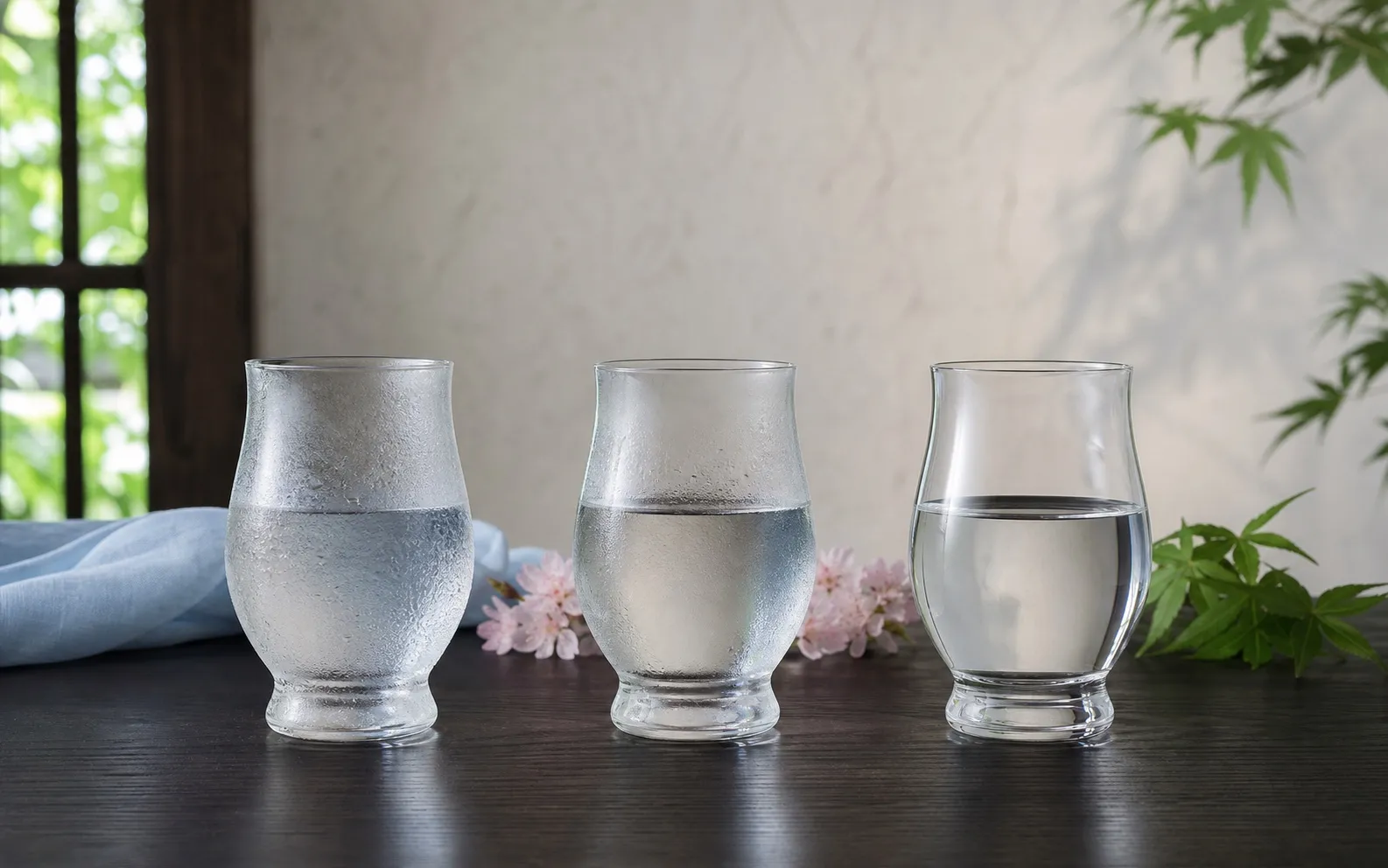
Start chilled, then follow the changes in your glass.
For chilled sake, about 5–15°C is a useful range to explore. You may see three Japanese names for temperatures within that range: 雪冷え (yukibie, about 5°C), 花冷え (hanabie, about 10°C) and 涼冷え (suzubie, about 15°C). They describe ways of serving sake, rather than separate kinds of sake.
At Sekinoichi Shuzo in Ichinoseki, Iwate, we suggest starting with a chilled bottle and noticing what happens as a small serving warms during a meal. The first sip may feel crisp and restrained. A little later, the same sake can seem more aromatic, with a softer impression of rice sweetness or savoury depth.
A summer evening is an inviting time to try this, but you do not need a special occasion or a table full of seafood. A small glass and something from your local supermarket are enough. The aim is to find a temperature you enjoy, rather than to reach an exact number on a thermometer.
Three names you may meet on a Japanese sake menu.
The temperature names offer a starting point for describing your preference. Keep the Japanese spelling alongside the explanation: it can help you recognise the words in an article, a shop display or a menu.
| Japanese name | Approx. temp. | What to notice |
|---|---|---|
| 雪冷えYukibie | 5°C / 41°F | A distinctly cold, crisp impression. Aroma and sweetness may seem quieter. |
| 花冷えHanabie | 10°C / 50°F | Still refreshing, with more aroma and flavour beginning to emerge. |
| 涼冷えSuzubie | 15°C / 59°F | Rice flavour, gentle sweetness and the finish may become easier to notice. |
These are approximate serving temperatures, not quality grades or rules that every bottle must follow. A refrigerator setting is also not a guarantee of the temperature inside your bottle. Time in the fridge, the amount of sake, the glass and the room all affect how cold a serving is.
You can use a thermometer if you enjoy comparing numbers. You can also begin with “straight from the fridge”, “still cool” and “a little less cold”. Those observations are useful even without a measurement.
A word to watch: 冷や and 冷酒. In sake terminology, 冷や (hiya) can mean unheated sake at room temperature; it does not always mean refrigerated. 冷酒 (reishu) means chilled sake. If you want a cold glass, asking for “reishu” is clearer.
Why the second sip can taste different.
At a lower temperature, sake can seem more restrained in aroma and sweetness, with a firmer outline on the palate. As it warms a little, aromas, rice flavour and a softer texture may become more apparent. The change is gradual, and it varies with the sake.
Imagine tasting a freshly poured glass and enjoying its clean finish. After a few bites of food, return to it. You might notice an aroma that was faint at first, or a sweetness that feels rounder. You have not changed bottles; you are finding a different side of the same drink.
Warmer does not automatically mean better. Chilling can bring a highly aromatic sake into a balance you prefer. Cooling too far can also make a delicate sake harder to appreciate. Your own impression matters more than a rigid recommendation.
Try to change one thing at a time. Taste the sake by itself, then with food, and then again after a short pause. Pouring a new bottle or adding several strong condiments at once makes it harder to tell what you enjoyed.
Choose for the whole dish, including the seasoning.
We often suggest starting with junmai sake when choosing a bottle for a meal. Within our range, a gently aromatic junmai offers a useful starting point for noticing the relationship between rice flavour and everyday food. This is our serving suggestion, not a claim that all junmai tastes alike.
“Sake goes with seafood” is too broad to choose a bottle by. Raw fish, grilled fish, fish simmered in miso and vinegar-cured fish bring different flavours to the table. Soy sauce, ponzu, ginger, garlic and myoga can change the pairing as much as the fish itself.
Begin with three questions.
- Is the dish delicate or rich? For mild white fish or squid sashimi, begin with a sake whose aroma is unlikely to dominate. For oily fish or a strongly seasoned dish, notice how the sake’s savoury depth meets the food.
- How has it been prepared? A grilled surface, a sweet simmering sauce and a vinegar cure create different starting points, even when the fish is the same.
- What remains after a bite? Consider the salt, citrus, ginger or garlic left in your mouth before you take the next sip.
A strongly aromatic junmai daiginjo can also be enjoyable alongside food, or on its own when you want to concentrate on its fragrance. There is no need to assign every category to one permanent role.
Start with food from a supermarket or konbini.
You do not have to source a full Sanriku seafood menu to try the ideas in this article. In Japan, chilled tofu, a dashi-flavoured omelette, edamame and salt-seasoned yakitori make accessible starting points. Choose food you already enjoy, then pay attention to what the sake adds.
| Label or menu name | What it is | A small pairing experiment |
|---|---|---|
| 冷ややっこ | Hiyayakko: chilled tofu | Begin with a little soy sauce. Add ginger or spring onion afterwards and compare. |
| だし巻き卵 | Dashimaki tamago: a dashi-flavoured rolled omelette | Notice whether the sake leaves room for the egg and broth flavours. |
| 枝豆 | Edamame: young soybeans | A simply salted portion lets you focus on the sake’s changing aroma. |
| 焼き鳥・塩 | Yakitori with salt seasoning | Compare a cooler sip with a slightly warmer one after a bite of grilled chicken. |
| しめ鯖 | Shime saba: vinegar-cured mackerel | Notice the combined effect of the fish’s fat and the vinegar. |
For a quiet tasting, choose two dishes rather than many. You may find that you prefer the cooler sake with one and the less-cold sake with the other. That is a useful discovery, not an inconsistency.
Six seafood pairings, with room for your own taste.
Sanriku, the Pacific coast of northeastern Japan, offers seafood with very different textures and aromas. Here are the points we suggest noticing. None of these combinations guarantees a match: sometimes a sake can make a seafood aroma feel more pronounced than you like.
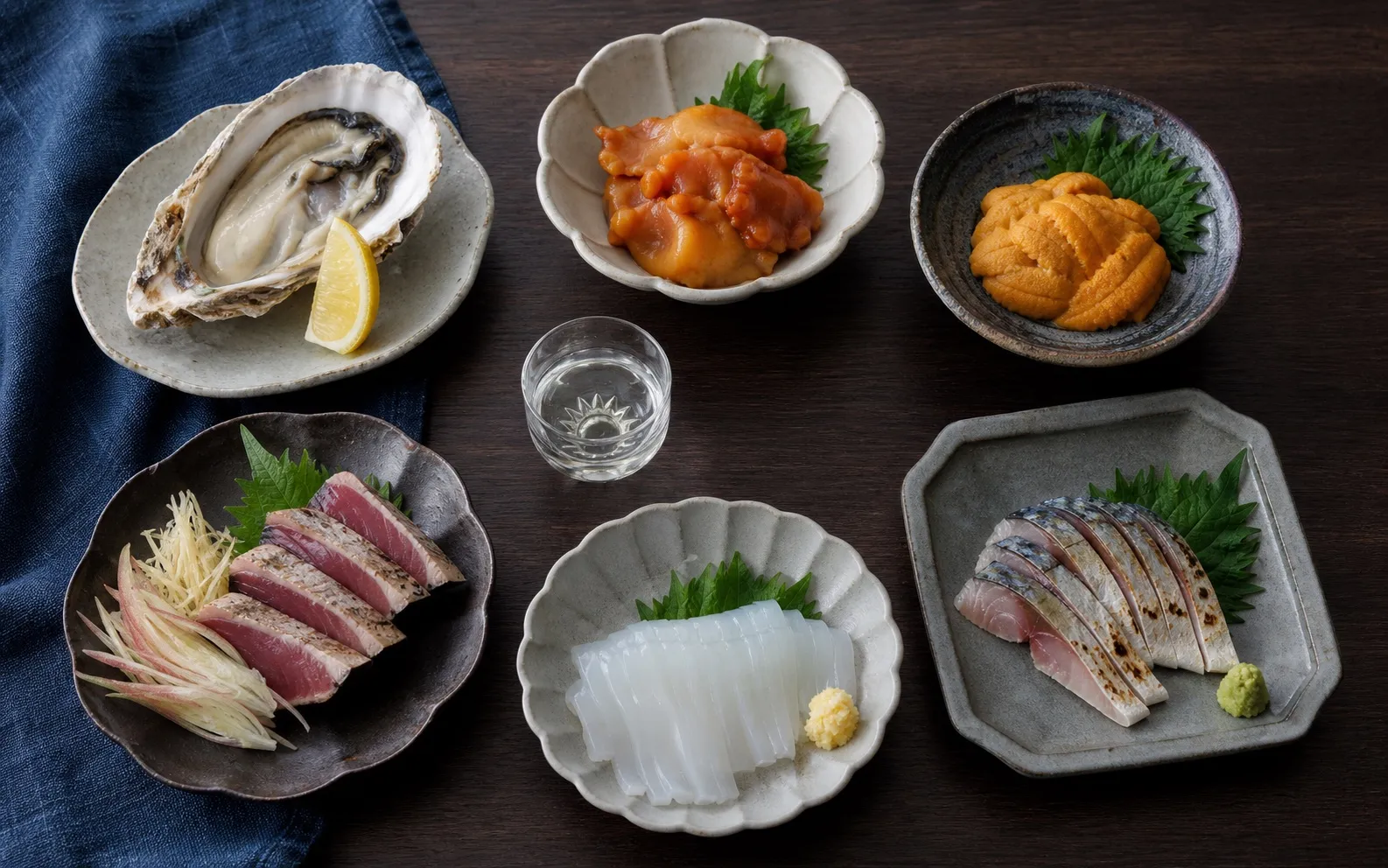
Oysters — 牡蠣 / kaki
Raw, steamed and grilled oysters differ in how their saltiness and savoury flavour come through. Try a small sip of a gently aromatic junmai and notice whether the oyster’s flavour remains pleasant. The cooking method is part of the pairing.
Sea squirt — ホヤ / hoya
Hoya has a distinctive marine aroma. Taste it first, then add a small sip of sake. Does the aroma become more appealing, or too strong for you? There is no need to force yourself to enjoy a combination simply because it is regional.
Sea urchin — ウニ / uni
Pay attention to the finish after a mouthful of uni. Begin with a sake that is gentle in aroma and see whether it leaves the seafood’s flavour room to linger.
Seared bonito — カツオのたたき / katsuo no tataki
The seared surface and the accompaniments matter: garlic, ginger, myoga and ponzu each change the dish. Try the fish with a little seasoning first, then compare after adding more.
Squid — イカ / ika
For delicate squid sashimi, start with a gently aromatic junmai. Grilled squid, particularly a more intensely seasoned preparation, calls for another comparison: include its toasted aromas and sauce when judging the balance.
Mackerel — サバ / saba
Salt-grilled mackerel, shime saba and seared shime saba bring different combinations of fat, vinegar and grilled aroma. Notice whether the next sip rounds out the meal or emphasises the fish’s aroma too much.
Choose what is available locally. Seafood availability changes with location, weather and season; you do not need all six ingredients to enjoy a comparison.
A relaxed fifteen-minute tasting at home.
“Fifteen minutes” is an invitation to slow down, not a schedule that produces a particular temperature. Your room, glass, serving size and starting temperature will change the pace. Keep the bottle appropriately stored and let a small serving provide the comparison.
- Chill the sake. Start with a bottle cooled in the refrigerator. An ice-water bath is another way to chill a closed bottle before serving.
- Pour a little. Use a small glass. A modest wine glass with a slightly narrowing rim is also useful when you want to notice aroma.
- Taste before eating. Notice coldness, aroma, sweetness, acidity and the finish. A few ordinary words are enough.
- Take a bite, then another sip. Compare the sake after your chosen dish. “I like this” or “the aroma feels too strong” is already a useful observation.
- Return to the glass after a pause. Try another small sip after about five to ten minutes. You may notice a change before then, or find that your glass is warming more slowly.
If you want to keep a note, record the temperature or cooling stage you preferred, the dish that worked best, when the aroma opened up, and which finish you enjoyed. The next time you buy a bottle, those notes give you a more personal starting point than a ranking.
Three ways to explore sake from Ichinoseki.
We value a soft, enveloping style in our sake. The soft water we use is one part of that approach; the rice, yeast and intended style also matter. For a first comparison, choose between a bottle for food, a bottle for its aroma and a sparkling sake for a toast.
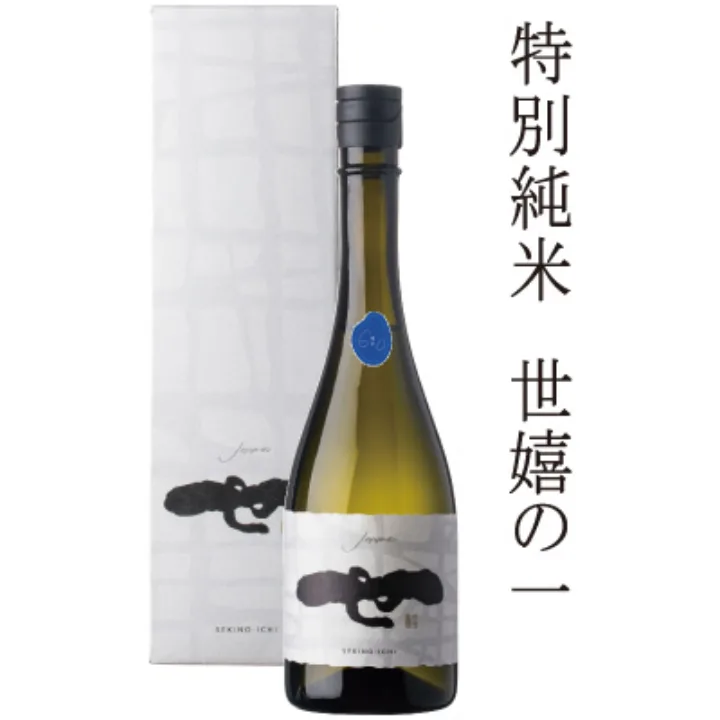
Tokubetsu Junmai · 特別純米酒 世嬉の一
Rice flavour and a clean finish. Our regular tokubetsu junmai is a starting point for a meal with grilled fish or other everyday dishes.
720ml · 15% to less than 16% ABV
View this bottle →Japanese product page; check current price and availability.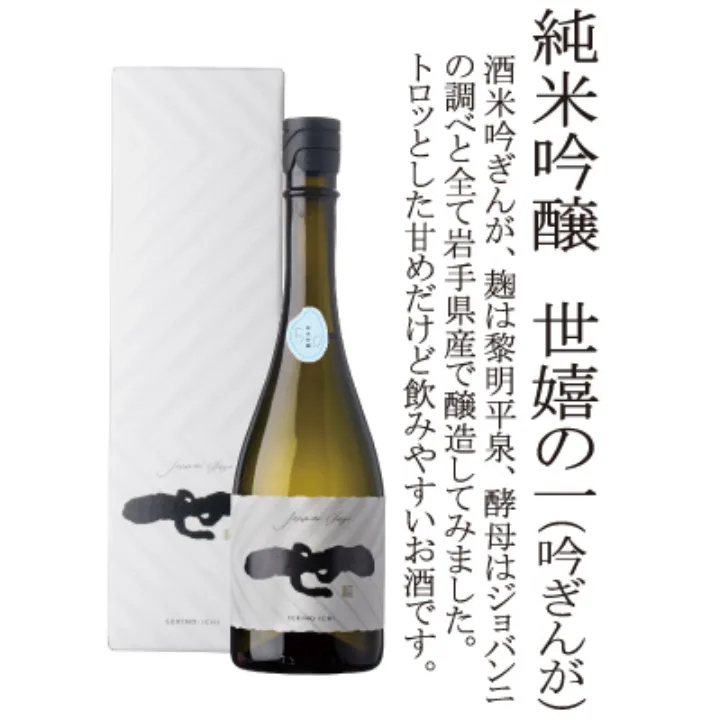
Junmai Ginjo “Gin Ginga” · 純米吟醸酒 世嬉の一「吟ぎんが」
Made with Iwate-grown Gin Ginga rice. Explore its floral aroma and gentle sweetness, first chilled and then a little less cold.
720ml · 15% to less than 16% ABV
View this bottle →Japanese product page; check current price and availability.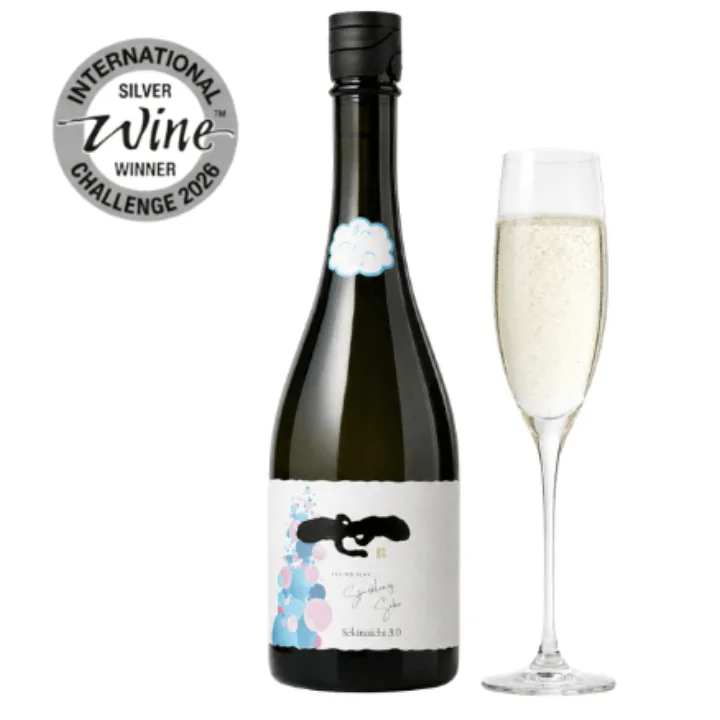
Sparkling Sekinoichi · スパークリング世嬉の一
Fine bubbles from fermentation and restrained sweetness. Try it well chilled for a toast, or with a salty or richer dish.
720ml · 15% ABV
View this bottle →Japanese product page; check current price and availability.Sparkling sake can be an approachable way to explore aroma and texture in a wine glass. Our 720ml sparkling sake is 15% ABV: bubbles and a gentle impression do not make it a low-alcohol drink. Chill it and follow the bottle’s opening instructions.
The seasonal labels in our Japanese article. Our summer collaboration with Ichinoseki illustrator Sachie Toda brings goldfish and fireworks to the labels. Seasonal availability and the selection can change. See the current summer-label collection in the Japanese shop; check the individual listing for its dispatch information.
Use the Japanese shop with the bottle name beside you.
Our English articles explain the choices; our product listings and ordering screens are in Japanese. Keep the Japanese name and size from this guide to hand so you can identify the same bottle. A 300ml bottle and a 720ml bottle are separate choices, even when the name looks similar.
On the product page, 数量 means quantity, カートに入れる means add to cart, and 購入手続き refers to checkout. Where age confirmation appears, answer it accurately. Check the delivery charge, dispatch information and storage instructions for your selection before confirming an order.
This guide is written for enjoying sake at home in Japan. Read our Japanese ordering and delivery guide for the store’s current conditions. For a broader explanation of sake labels and bottle sizes, return to our beginner’s guide in English.
Questions about chilled sake.
What temperature is yukibie?
About 5°C. It describes a distinctly chilled serving. Hanabie is about 10°C and suzubie about 15°C; treat all three as approximate guides.
How long should I wait after taking sake out of the fridge?
There is no fixed waiting time. Try a small serving, then return to it after five to ten minutes. Room temperature, the glass and the amount poured all affect the result.
Does every sake go with sashimi?
No single pairing suits every fish, preparation or preference. Begin with a gently aromatic junmai, then consider the seasoning and whether the sake makes the seafood’s aroma stronger than you enjoy.
Can I use a wine glass?
Yes. A small wine glass with a slightly narrowing rim is one way to explore aroma. A special sake cup is not necessary to begin.
Are these temperatures also storage instructions?
No. They are serving suggestions. Follow the storage directions on the bottle and product listing, particularly for sake that needs refrigeration. Do not use a serving guide to override those instructions.
Do I need to choose a summer-only sake?
No. You can explore these temperatures with a suitable regular bottle, too. Seasonal labels are another option, subject to the current selection in our Japanese shop.
About this guide
Written by Sekinoichi Shuzo, with explanations for readers living in Japan. Adapted from our Japanese article. Product details were checked on 13 September 2026. Current product listings, labels and enclosed instructions take precedence for ordering and handling.
Sake serving reference: Japan Sake and Shochu Makers Association